Featuring insights from experienced interventional MRI clinicians and the Copernicus support team

A structured pathway to iMRI readiness
Interventional MRI demands more than new equipment. It requires a coordinated safety culture, procedural mastery, and operational alignment.
Copernicus is Cook Medical’s training and readiness service, designed to prepare institutions for safe, scalable iMRI implementation.
This is not a training course. It is an adoption framework.
- Built for safe implementation
MRI-guided intervention introduces unique safety, workflow, and device considerations.Copernicus supports:
- MRI-safety governance and protocol development
- suite configuration and procedural flow planning
- role-based training for physicians, technologists, nurses, and anesthesia teams
- MR-conditional device handling and procedural integration
The goal: readiness before first case.
- From first case to program maturity
Copernicus extends beyond the day iMRI goes live.Institutions receive:
- on-site and virtual clinical education
- workflow optimization guidance
- ongoing procedural support
- technical coordination and troubleshooting
We help hospitals move from pilot procedures to sustained clinical programs.
- Multidisciplinary alignment
Successful iMRI programs require collaboration across:
- interventional radiology
- oncology
- cardiology
- MRI technologists
- nursing and anesthesia
- facilities and safety officers
Copernicus aligns stakeholders around shared protocols, safety standards, and procedural objectives.
- Designed for confidence
By combining structured planning with clinical mentorship, Copernicus equips teams to perform MRI-guided biopsies, ablations, and focal therapies with precision and consistency.It transforms uncertainty into capability.
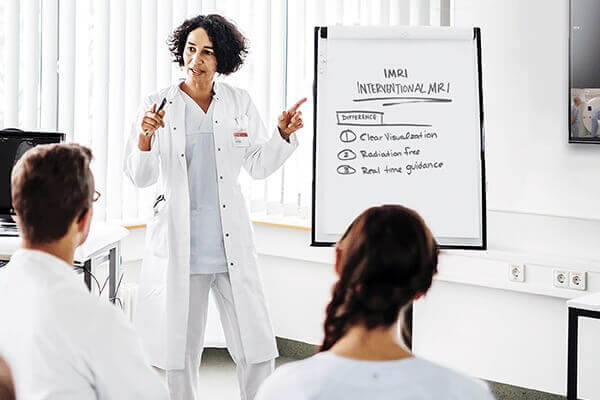
Physician and staff guidance
- Dedicated implementation specialists guide suite design, workflow mapping, and staff training.
- On-site and virtual education modules help clinicians transition from current image-guided practice into MRI-guided intervention.
- Ongoing clinical-support visits and technical assistance keep your program running smoothly.
"This is a technology that can legitimately allow us to clear a liver of multiple metastases more accurately than CT or ultrasound."
Frequently asked questions
What is interventional magnetic resonance imaging (iMRI)?
Interventional magnetic resonance imaging (iMRI) combines continuous MR imaging with minimally invasive procedures, offering excellent soft-tissue visualization and rapid, precise targeting of difficult lesions, all without exposing patients or clinicians to ionizing radiation. This approach enables clinicians to perform interventions with greater precision and safety.
How does continuous MRI guidance improve patient safety during procedures?
iMRI enhances patient safety by providing real-time, high-contrast imaging without ionizing radiation. This means clinicians can precisely target lesions and adjust procedures as needed, reducing the risk of complications and unnecessary exposure. The system’s design also supports ergonomic access and streamlined workflows.
What is the strategic partnership between Cook Medical and Siemens Healthineers?
Cook Medical and Siemens Healthineers have collaborated to establish a turnkey solution for interventional MRI (iMRI). This partnership combines Siemens Healthineers’ advanced imaging technology with Cook’s clinical solutions, creating a new gold standard in patient care. This strategic collaboration creates a unique alliance between industry leaders in imaging and interventional devices—one that has not existed before.
How do Cook Medical and Siemens Healthineers collaborate on the iMRI Suite?
The companies collaborate by integrating imaging innovation with procedural expertise to deliver a complete framework for iMRI implementation. This partnership enables the development of a turnkey ecosystem that includes site planning, imaging, interventional devices, and procedural support. Hospitals benefit from a comprehensive suite that streamlines workflow, supports MRI-guided interventions, and ensures every component, from equipment to training, works together for successful outcomes.
What advantages does this industry partnership bring to hospitals?
Hospitals gain several advantages from the iMRI partnership:
- comprehensive iMRI Suite: seamless adoption and scaling of real-time MRI-guided procedures
- radiation-free imaging: eliminates ionizing radiation exposure for patients and staff
- enhanced precision: real-time, high-contrast imaging to improve targeting and procedural accuracy
- operational efficiency: ergonomic suite layouts and devices designed for MRI to streamline workflow
- support model: training, planning, education, and clinical guidance before, during, and after installation