Collaboration: The Key to Our Success
The situation
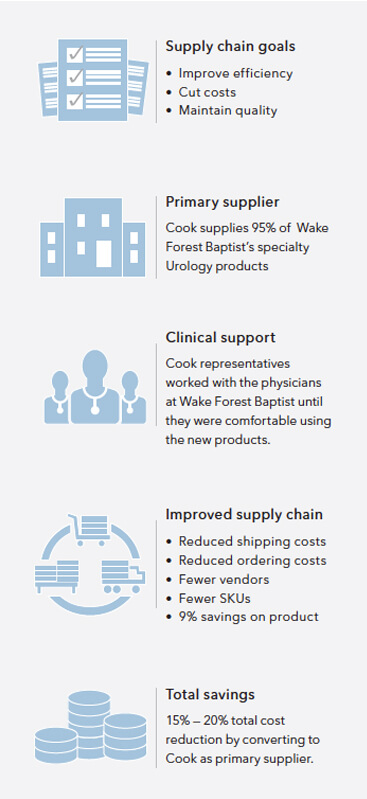
Wake Forest Baptist Medical Center wanted to find ways to improve its supply chain and save money. Wake Forest Baptist wanted to reduce costs across its entire supply chain system by making it more efficient, not just by cutting line-item expenses. To accomplish these goals, in early 2011, Wake Forest Baptist hired Conrad Emmerich as vice president of resource management and Bill Brewer as director of strategic sourcing.
Soon after Conrad and Bill started at Wake Forest Baptist, Cook Medical representatives met with them to learn what their goals were. The Healthcare Business Solutions (HBS) team for Cook Medical provided supply chain support. The team consisted of Mike Hughes, vice president of supply chain and distribution; Bill Anton, corporate account executive; and Steve Clemmer, corporate account manager for Cook’s Urology division.
A rapid response
After they learned about Wake Forest Baptist’s goals for supply chain improvement, the HBS team members presented the goals to Cook Medical’s clinical divisions. Cook’s Urology division was quick to submit a proposal. Because Cook’s proposal was submitted early in the process, Wake Forest Baptist gave Cook priority attention.
The clinical side
In addition to supporting the hospital supply chain staff, Cook Medical also wanted to make sure that the physicians were confident about using the products. Cook district manager, George Beasley, trained the physicians in the OR until they were comfortable with using the new products. Once all the physicians were completely comfortable with using Cook’s products, Wake Forest Baptist accepted Cook’s urology proposal.
The results
This project had an immediate effect. Wake Forest Baptist reduced its shipping expenses because it could more easily combine orders and reach the $200 minimum that Cook requires for free overnight shipping. It allowed Wake Forest Baptist to consolidate 90 percent of its specialty urology disposable devices with one vendor—Cook—with projected savings of 15 to 20 percent. By working with fewer vendors for urology orders, Wake Forest Baptist reduced its ordering costs. Using a primary vendor makes the supply chain easier to manage and reduces the number of SKUs to track in inventory. For items that Wake Forest Baptist had already been purchasing from Cook, costs were reduced by 9 percent, because of the increased volume of orders.
“Wake Forest Baptist Medical Center has completed a successful supplier consolidation and cost reduction project in urology,” said Jonathan Kepley, manager of contract administration at Wake Forest Baptist Medical Center. “Focusing on disposable specialty urology products, we partnered with Cook Medical to standardize to a majority supplier. This partnership has allowed us to provide the clinicians with superior products, reduce our inventory, and reduce our costs within urology.”
Contact your Cook Medical representative to inquire about cost savings for your facility.
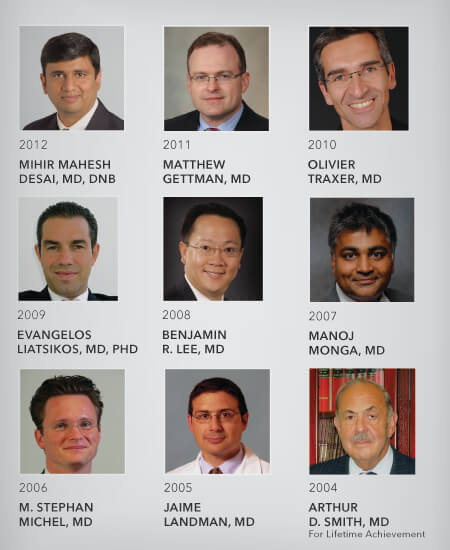
The 2013 Arthur D. Smith Endourology Lectureship was presented to Thomas Knoll, MD, associate professor of urology at Mannheim University Hospital, Germany, and head of the Department of Urology, Sindelfingen-Böblingen Medical Center, University of Tübingen, Germany.

Dr. Knoll received the award for his extensive scientific and clinical work on the interventional treatment of urolithiasis and benign hyperplasia. He recently performed a large study on the pathogenesis and prevention of calcium oxalate and cystine stone formation. A special presentation during the 2013 World Congress of Endourology & SWL (WCE) annual meeting in New Orleans, LA, honored Dr. Knoll for his accomplishments.
Cook Medical is proud to partner with societies to recognize physicians for their creativity and dynamic innovation in the field of urology. Each recipient, chosen by the Endourological Society, must be within the first 10 years of practice after completing a urology residency or fellowship.
The initial award was presented to Dr. Arthur Smith, the famed “father of endourology,” in 2004 and was subsequently named in his honor. It was presented as a lifetime achievement award at the end of his presidency of the Endourological Society at the WCE annual meeting in Mumbai, India.
Throughout his career, Dr. Smith remained one of the leading innovators in the field of endourology, pioneering several new operative techniques that are used in the percutaneous treatment of kidney stones and transitional cell carcinoma, and in endopyelotomy.
Bloomington, Ind. —Cook Medical has a new device to simplify percutaneous nephrolithotomy (PCNL) procedures, during which physicians break up and remove large kidney stones, or can use it in the bladder to break up large bladder stones. LithAssist™ combines suction control and provides access for a laser fiber. It is the first device globally to provide suction control and laser fiber access. Approximately 67,000 PCNL procedures are performed each year in the United States, and 466,000 are performed globally.1
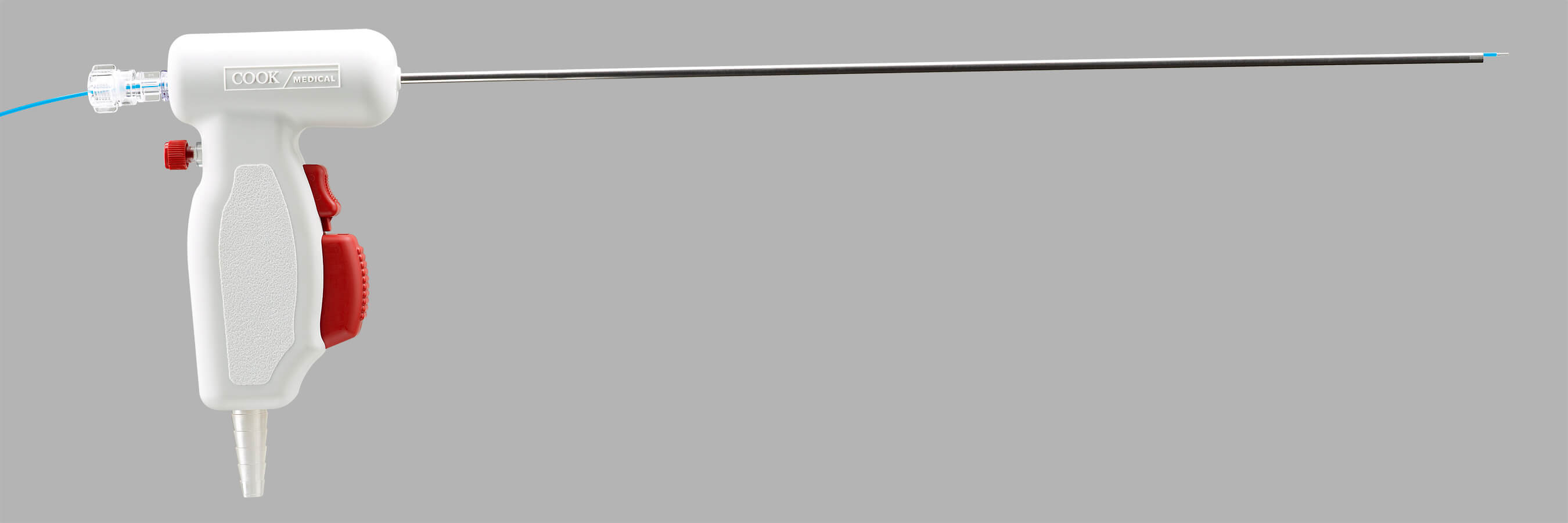
Prior to the availability of LithAssist, an assistant controlled suction by kinking a tube, similar to how one would stop water flow from a garden hose. LithAssist allows physicians to control suction more easily during the procedure. The ergonomic handle allows the physician to position the laser fiber and suction with one hand. Not only does this synchronize the procedure by giving the physician more control, but it also can free an assistant to help with other aspects of the procedure.
LithAssist works with any holmium laser, so hospitals can use their current equipment and don’t have to purchase any additional capital equipment.
“Our goal for this product is to help physicians use their lasers for PCNL procedures in a simple way,” said Jean-Marc Creissel, global leader of Cook Medical’s Urology division. “Streamlined procedures are beneficial for the physician, the hospital and ultimately the patient. This is just one more example of our commitment to solving problems for physicians.”
About Cook Medical
A global pioneer in medical breakthroughs, Cook Medical is committed to creating effective solutions that benefit millions of patients worldwide. Today, we combine medical devices, drugs, biologic grafts and cell therapies across more than 16,000 products serving more than 40 medical specialties. Founded in 1963 by a visionary who put patient needs and ethical business practices first, Cook is a family-owned company that has created more than 10,000 jobs worldwide. For more information, visit www.cookmedical.com. Follow Cook Medical on Twitter and LinkedIn. Follow Cook Medical Urology on Twitter as well.
1 Cook Medical internal market estimates
Since 1963, Cook Medical has been collaborating with physicians to bring new product ideas to market. We are always looking for ways to create solutions to complex problems. This way of thinking has made a difference in millions of patient’s lives.
Cook’s collaborative efforts in urology date back almost 40 years. In 1974, Dr. Al Rutner provided Bill Cook with a list of devices to develop.
Dexter Elkins, vice president of marketing, remembers those days.
“From the very beginning Bill had an understanding and appreciation for clinician ideas,” Elkins stated. “It’s been clear to us since then that collaboration with the physician is key. We as a company, and the clinician as a caretaker for patients, are beneficiaries of collaboration. That relationship is really important. We wouldn’t be here without it.”
The following Cook exclusives are just two of the innovations that have come from physician collaborations.
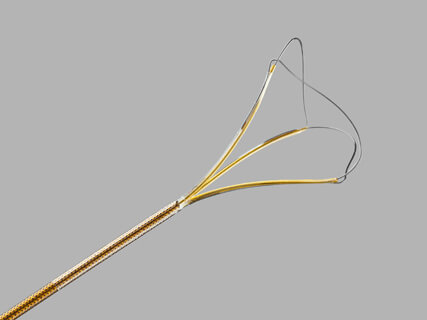 The NGage Nitinol Stone Extractor is not just a grasper or stone basket, it’s a combination of the two. This patented device engages, repositions, releases, and extracts stones of various sizes throughout the urinary tract. The NGage has 50% greater retention strength than traditional graspers.1 Likewise, in a calyceal model, the NGage demonstrated a superior ability to release simulated stone fragments in comparison to both standard and multi-wire nitinol baskets.1
The BIGopsy Backloading Bi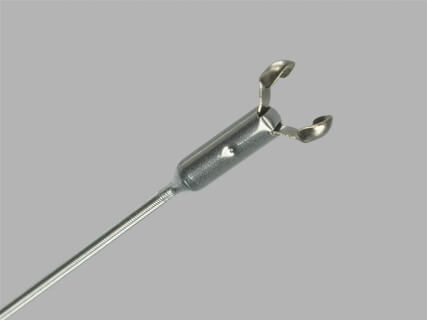 opsy Forceps helps you obtain larger samples of tumors from within the kidneys or ureters. The device’s 4 mm3 cup gives you a larger sample than any other device on the market and increases your chance of getting an accurate diagnosis without costly repeated procedure
Contact your local Cook Medical representative for more information on these and other product innovations.
1. Lucas SM, Zeltser IS, Bensalah K, et al. In vitro evaluation of the retention strength of a novel nitinol stone extractor (NGage®) compared to a standard three-pronged grasper. J Endourol. 2007;21(suppl 1):MP33-17.